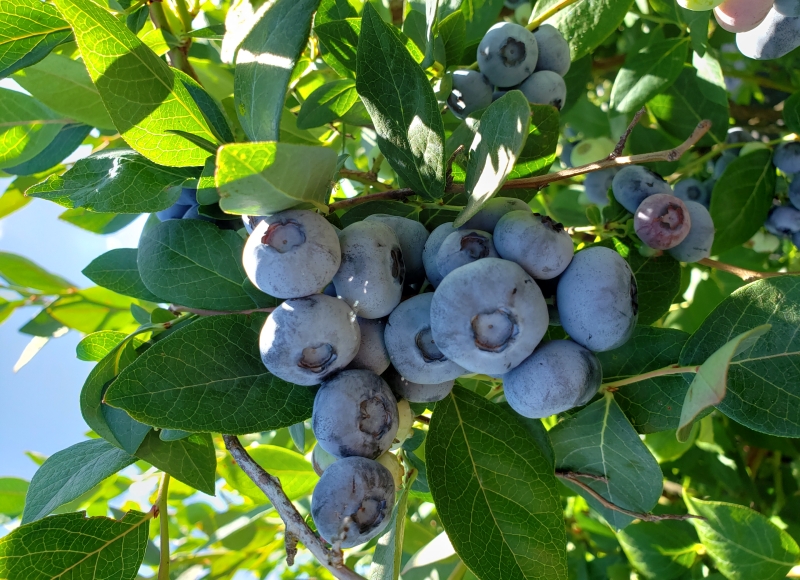
Cultivated highbush
(Vaccinium corymbosum
L.) and wild lowbush (Vaccinium
angustifolium Ait.)
blueberries are excellent sources of phytochemicals
that are believed to have significant biological
activity. The objective of this study was to determine whether incorporation of
blueberries into food products affects their phenolic
content or antioxidant and antiproliferation
activity. Several blueberry fruit–containing products including fresh,
individually quick frozen (IQF), freeze-dried,
spray-dried, heat-dried, cooked, juice concentrate, pie filling, and jam were fractionated to remove sugars and isolate groups of phytochemicals based on solubility. The fractions were
analyzed for total phenolics and assayed for ferric
reducing antioxidant power (FRAP) antioxidant activity, 2,2-diphenyl-1-picrylhydrazyl
(DPPH) radical scavenging activity, and hepa-1c1c7 antiproliferative activities. For both cultivated and wild
berries, fresh and IQF berries had the highest total
phenols, antioxidant activity, and antiproliferation
activity. Whole freeze-dried wild blueberries also retained
significant antiproliferative activity in 2 fractions eluted with acetone (fraction 4, 4% of
control cell growth at 20 mg/mL) and 50% aqueous acetone (fraction 5, 69% of control cell growth
at 20 mg/mL) and ranked
close to the activities recorded for fresh (30% of control cell growth at 20 mg/mL for fraction 5) and IQF whole fruit (27% of control cell growth
at 20 mg/mL for fraction 5).
Products that were heat-processed retained most of the antioxidant activity and
total phenolics found in unprocessed whole fruit.
However, the heat-treated products lacked or had diminished antiproliferation
activity, suggesting that although products may be high in phenolic
compounds and antioxidant activity, some forms of bioactivity may be compromised by harsh processing methods.
Keywords: Vaccinium, blueberry, processing, antiproliferation, antioxidant